
Back to Blog
The Future of Preventive Medicine: Built for the AI Generation
Three in four Gen Z adults turn to AI before seeing a doctor, and nearly all physicians look at wearable data – yet almost none of it makes it into routine care. Meanwhile, our societies are ageing. Why preventive medicine has to be built for a new generation, and what a bridge between personal data and medicine could look like.

Lisa Patterer, MSc
MSc (Medical University of Vienna)
· 6 min read

The future of preventive medicine has to be built for people who already measure and question their own health – with a tracker on their wrist and AI in their pocket. In a recent US survey, 76% of Gen Z and 63% of millennials said they turn to AI for health questions before seeking professional care 1. At the same time, nearly all physicians look at their patients' wearable data, yet hardly any can build it into treatment 2. And while that gap widens, our societies are ageing: in Austria, one in four people is expected to be 65 or older by 2040 3.
Last night I sat with a friend and we kept circling back to one question: who are we actually building tomorrow's medicine for? Our answer has stayed with me ever since.
Why is the next generation of patients so different?
Because it is growing up with a completely different sense of ownership over its health. I am being trained in a system that grew, over decades, around people who only saw a doctor once something felt wrong. That wasn't negligence – it was simply how things worked.
The people who will walk into our practices in ten or twenty years are not smaller versions of today's patients. They ask AI first, check their sleep data over breakfast and compare their resting heart rate to last month's. The Aflac survey also reveals a flip side that concerns me more than the AI figure itself: 65% of Gen Z and 61% of millennials said they delay or skip routine check-ups and screenings 1.
This generation isn't less interested in health – quite the opposite. But the traditional system is no longer reaching them. That's not a threat. It's an invitation to rethink prevention.
Is this shift really new?
In one crucial way, yes. Medicine has always changed: germ theory, antibiotics, imaging, sequencing the human genome. But progress almost always came from the side of medicine – new devices, new drugs, new diagnostics in the hands of professionals.
Today's shift isn't entirely without precedent: people with high blood pressure or diabetes have measured themselves for decades. What's new is the scale. Health data is now generated continuously, voluntarily and in vast amounts on the patient side, outside any clinic – and AI makes it interpretable for non-experts. That changes who holds knowledge about the body first.
Do trackers and health data actually make a difference?
Yes for behaviour – the evidence for what happens inside the body is thinner. A large umbrella review summarising dozens of systematic reviews found that people using activity trackers walk around 1,800 more steps per day on average 4. From a public health perspective, that's a meaningful effect.
For physiological health markers, the picture is more cautious: effects pointed in the right direction but were mostly small and often inconclusive 4. That's not a reason for scepticism – it's an important clue. Wearables are very good at measuring what we do. Whether that changes blood sugar, blood lipids or inflammation is something they can't see. That is exactly the next gap to close.
We already measure almost everything we do. We rarely see what it does inside our bodies.
Why isn't this data reaching medicine?
Not for lack of interest, but for lack of structures. An international survey of 2,222 physicians in six countries, including Germany, by the American Medical Association and Medscape paints an almost absurd picture: 97% review their patients' wearable data in some way, and most see clinical value in it 2. Yet in no country had more than 6% of physicians actually integrated this data into their clinical workflow 2.
The reasons are structural: missing reimbursement, missing workflows, uncertainty about liability and data quality 2. Tellingly, physicians who already use wearable data report greater trust in its accuracy and more confidence interpreting it 2. So the need isn't just for more data, but for data that is clinically reliable and arrives in a format doctors can work with.
Why is this becoming more urgent now?
Because the gap won't close on its own while society ages. In Austria, the share of people aged 65 and over is projected to rise from 20% in 2024 to 26.2% by 2040, according to Statistics Austria 3. Older adults need considerably more care: in the US, people over 65 are estimated to see doctors around 20% more often and to be hospitalised about three times as often as younger adults 5.
A system built for fewer, younger and largely reactive cases is meeting a reality that demands the opposite. Every year a chronic disease starts later relieves not only the person affected, but the entire system.
What could preventive medicine look like if people regained ownership of their health?
Imagine prevention wasn't an appointment you keep postponing, but a process you steer yourself. You don't just know how many steps you take, but what they do for your metabolism. You notice when a value starts drifting in the wrong direction – long before it becomes a problem. You get recommendations based on your own values, not on an average person. And you walk into your doctor's office not with a gut feeling, but with a documented history.
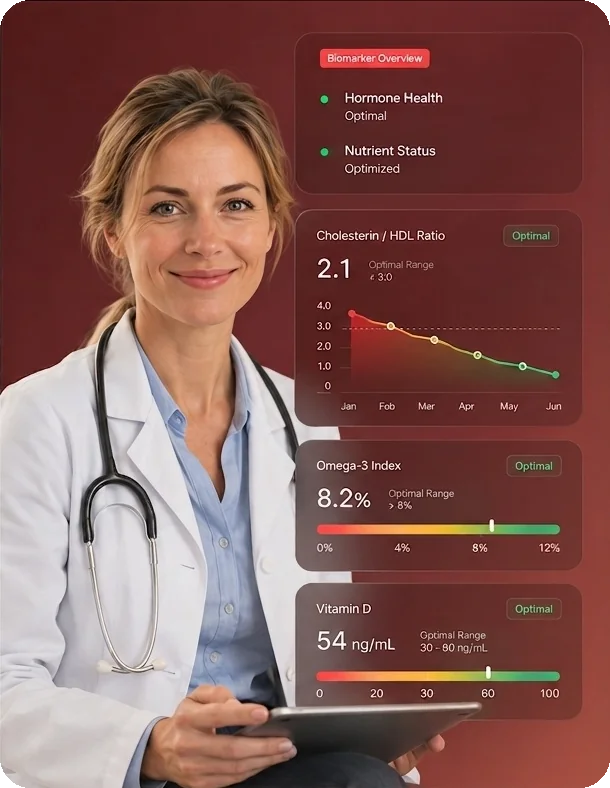
That's the bridge we're building at speak23. With speak23, you measure your blood values two or four times a year. Every result is recorded digitally and automatically, so your history, trends and changes are visible in the app. Building on that, you receive personalised, evidence-based recommendations designed to steer your trends in the right direction. And the app accompanies you along the way, showing how your changes affect your values.
Blood values add what wearables can't: a view of what is actually happening inside the body. Whether this kind of approach prevents disease in the long run is something research still has to show. But it targets precisely where today's biggest gaps are – continuity, the link between behaviour and biomarkers, and data reliable enough to work with.
What can you do today?
- Connect behaviour and effect. Your tracker shows how you move and sleep. With speak23, you measure two or four times a year what that means for your blood values – start with the speak23 Core Health blood test.
- Watch trends, not single values. Your results go straight into the speak23 app, so you can see whether something is stable, improving or slowly getting worse.
- Use AI as a starting point, not the end point. General answers are a good first step. The recommendations in the speak23 app, by contrast, are evidence-based and tailored to your own values and how they change.
- Make progress visible. With every new measurement, the app shows how your changes have affected your values – making prevention tangible.
- Don't skip check-ups – complement them. speak23 does not replace a medical examination or diagnosis. Bring your documented history to your next check-up; it makes the conversation with your doctor more concrete.
What does this mean for us as the next generation in medicine?
Maybe this is our task as future doctors, scientists and founders: not to wait until the system is ready. The people we're being trained for won't wait anyway. We can build the bridge ourselves – between what people want to know about themselves today and the care an ageing society actually needs.
I don't yet know exactly what that bridge will look like in every detail. But since that evening, I'm clearer about what we're building it for: a medicine in which people don't have to become patients first in order to be well cared for.
Gallery

Sources
- Aflac Incorporated. 76% of Gen Z and 63% of millennials turn to AI for first line of primary healthcare — Aflac Newsroom (2026) · Cross-sectional study
- American Medical Association Center for Digital Health and AI, Medscape. International physician survey on consumer wearables — American Medical Association (2026) · Cross-sectional study
- Statistik Austria. Bevölkerungsprognose 2025 — Statistik Austria (2025)
- Ty Ferguson, Timothy Olds, Rachel Curtis, Henry Blake, Alyson J Crozier, Kylie Dankiw, Dorothea Dumuid, Daiki Kasai, Edward O'Connor, Rosa Virgara, Carol Maher. Effectiveness of wearable activity trackers to increase physical activity and improve health: a systematic review of systematic reviews and meta-analyses — The Lancet Digital Health (2022) · Systematic review · DOI: 10.1016/S2589-7500(22)00111-X · PMID: 35868813
- Charles H. Jones, Mikael Dolsten. Healthcare on the brink: navigating the challenges of an aging society in the United States — npj Aging (2024) · Review · DOI: 10.1038/s41514-024-00148-2 · PMID: 38582901
About Lisa Patterer, MSc
Chief Medical and Scientific Officer
Lisa Patterer holds an MSc in Molecular Precision Medicine from the Medical University of Vienna and a BSc in Molecular Biotechnology. She has gained international research experience at institutions including Harvard Medical School and the University of Barcelona.
- MSc, Medical University of Vienna (2025)
This article is for general information and does not replace medical advice, diagnosis or treatment. Always discuss health questions and lab results with your doctor.