
Back to Blog
Supplementing as a Trend? Why Measuring Decides What Your Body Actually Needs
Supplements are everywhere on social media — often without evidence-based guidance behind them. At the same time, a long-term analysis of over 1,000 healthy adults shows that repeated blood testing can help tell what actually works from what doesn't. Why something orthomolecular medicine has argued for decades is now reaching mainstream medicine — and why your own needs are never constant.
Lisa Patterer · 2 min read

Why is supplementing such a trend right now?
A recent rapid review on social media's influence on dietary supplement use found a clear pattern among young adults: those exposed to a lot of supplement-related content were more likely to adopt unsubstantiated health claims, more susceptible to marketing, and more likely to change their diet based on online content than on professional advice. The issue isn't supplementing itself — it's that it often happens without a real basis, driven by trends rather than actual need.
Orthomolecular medicine has focused on exactly this for decades
The term "orthomolecular" — roughly, "the right molecules in the right amount" — was coined back in 1968 by Nobel laureate Linus Pauling. The core idea: the body needs certain nutrients and compounds in a concentration that fits the individual, not a blanket dose for everyone. What was once a fringe position increasingly aligns with what data-driven preventive medicine is now showing.
Why does measuring more often pay off?
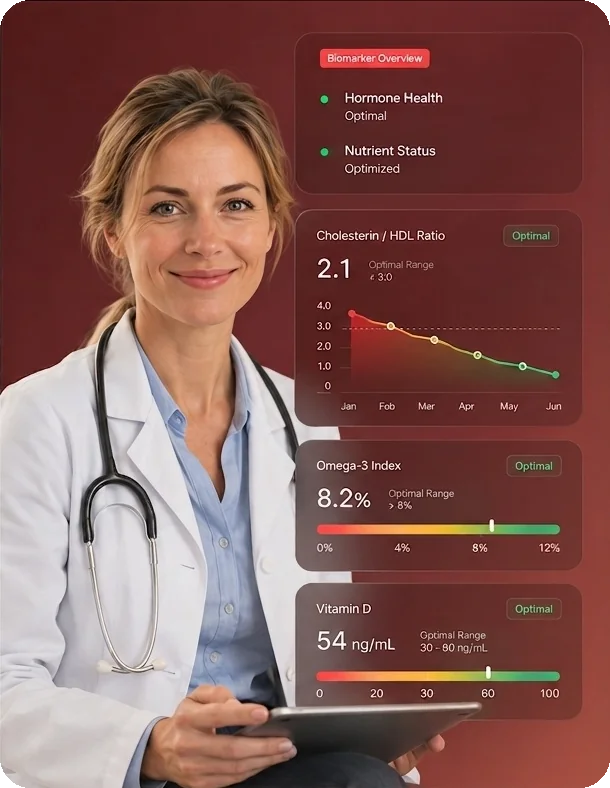
A long-term observational study of over 1,000 healthy adults found that people with abnormal baseline blood markers largely showed clear improvement on retesting after targeted adjustments. Without a follow-up measurement, it's unclear whether a supplement is actually doing anything — whether the body is using what it's given, or it's simply being taken. Only the combination of measured values and how you actually feel — energy, fatigue, mood, focus — reveals what your body genuinely needs.
Needs are never constant
As we age, the ability to absorb many nutrients changes noticeably: reduced stomach acid more often limits vitamin B12 absorption in older adults, and the body's own activation of vitamin D declines too. Pregnancy, sport, or the menstrual cycle shift requirements just as clearly. A value measured once is never valid forever.
The real shift in mindset isn't taking more supplements — it's measuring more deliberately, and taking the body's answers over time seriously.
"That's a real opportunity for medicine built around the person, not the trend."
Gallery
Sources
- Nihitha Devanaboyina, Vishwadha Khatri.. The influence of social media on dietary supplement use: a rapid review — International Journal of Community Medicine and Public Health. (2026) (2026) · DOI: 10.18203/2394-6040.ijcmph20261809
- Linus Pauling.. Orthomolecular Psychiatry — Science. (1968) · DOI: 10.1126/science.160.3825.265
- Westerman, K., Reaver, A., Roy, C. et al.. Longitudinal analysis of biomarker data from a personalized nutrition platform in healthy subjects — Sci Rep 8, 14685 (2018). (2018) · DOI: 10.1038/s41598-018-33008-7
- Hajnal Finta, Calin Avram, Corneliu-Florin Buicu,Daniela-Edith Ceana,,Iuliu Moldovan and Florina Ruta. Micronutrient Status, Health Implications, and Assessment Aproaches in Older Adults: A Narrative Review of Recent Studies — Life. (2026) (2026) · DOI: 10.3390/life16040570